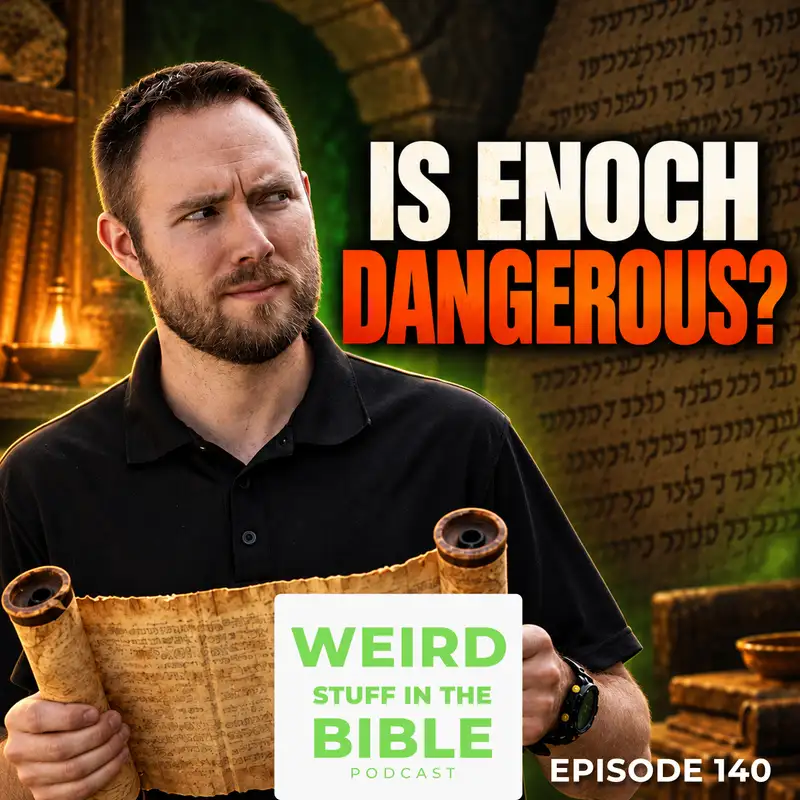
3 Dangers of the Book of Enoch- and Why You Should Read It Anyway
Download MP3The Dangers of the Book of Enoch: A Retrospective on this Year’s Study
Review of the Enoch Series
Introduction
You will often hear people claim that it’s “dangerous” for Christians to read the Book of Enoch.
And that’s literally the word that they’ll use. Dangerous.
I’m not trying to pick on anyone so I won’t name names, but if you google it, you’ll find plenty of people telling you that the Book of Enoch should be avoided because it can be so dangerous to your faith.
Now, I often find these fears a little silly and overblown. I mean, if I thought that the book of Enoch was dangerous to read, I wouldn’t have spent the first six months of this year studying it.
However, now that I have, I would say I think there’s one—maybe two—maybe even three fair criticisms that someone could levy against the book of Enoch.
So I want to share my thoughts on those, and then give a few reasons why I actually believe all Christians should study the book of Enoch anyway.
So it’s not so much a bible study today as it is a reflection or retrospective on this year’s study. But I’m laid up at home recovering from surgery this week, and so these are some of the thoughts swirling around in my head.
[theme music]
Enoch: The Rest of the Story
Welcome to Weird Stuff in the Bible, where we explore scripture passages that are bizarre, perplexing or just plain weird. This is Luke Taylor, and this week I’m home recovering from a surgery. It wasn’t any kind of major surgery, it was just a hernia repair, but man, it has taken a lot more out of me than I expected. Like, I was kinda looking forward to taking a week off work, just taking it easy and letting my wife bring me coffee and spending a bunch of time working on podcasts or watching that new black-and-white Spiderman show that they put on Amazon.
And, this week has been harder than I expected, I’ll just admit. I haven’t felt like doing much of anything. But I have been thinking over our Book of Enoch series and I have a few thoughts I thought I just might share today.
And let me start with Paul Harvey. If you don’t know that name, Paul Harvey was an old time radio broadcaster. If you do know that name, you’re probably a bit of an old-timer yourself. Paul Harvey was a war correspondent during WWII and then after the war reported on what soldiers were doing with their lives after the war. He started doing a segment where he researched the origins of random things, and it became so popular that it eventually became it’s own show, which was titled “The Rest of the Story.” For decades, Paul Harvey did the research to learn the origin stories of things like Walt Disney, Coca-Cola or the telephone, and then he would tell the story in a mysterious way so that you didn’t know what famous person you were hearing about until you got to the very end of the segment. And once he revealed the surprise, he would end with the phrase: “and now you know the rest of the story.”
Reading the Book of Enoch this year has felt like a bit of a biblical “rest of the story.” I’ve even dropped that line in a few episodes this year. As we’ve studied Enoch- and we actually only covered the first 16 chapters of Book 1 of Enoch- I’ve had so many ‘aha’ moments and surprises at seeing connections between this book and the worldview of the Bible writers. Times where a plot point from Enoch pieced together some kind of biblical mystery in my thinking and unlocked the Bible for me. I’ll review some of those today.
Matthew 13:52 says
“…every scribe who has been trained for the kingdom of heaven is like a master of a house, who brings out of his treasure what is new and what is old.”
And that’s what I’ve felt like as I got to explore Enoch. It’s a privilege. I’ve found treasures new and old. They’re old because they were written down long ago, but they’re new because so few people have studied these things in modern times that I often feel like I’m in uncharted territory.
Now, being in uncharted territory can have positives and negatives associated with that. When you’re stepping off the reservation just a bit, it can be exciting because you’re finding things that haven’t been found before, or are just extremely obscure. It’s like going on an adventure for buried treasure. You don’t know what you might find, or how valuable it might be. And it’s actually so much more valuable than real gold, because it’s unlocking God’s Word.
But there’s also a risk with uncharted territory, and it’s that you can get into dangerous regions because there aren’t the typical boundaries you’re used to. When you study the Bible itself, you have doctrines and creeds that can frame your thinking and keep you within the realm of orthodoxy. But when you go outside the Bible and study, for instance, Second Temple literature, you don’t necessarily have those same guardrails. You might have them, but the book you’re reading isn’t necessarily hemmed in by those things.
So as I’ve reflected on this study, I can identify three things that I would say are legitimate dangers that come with studying the Book of Enoch.
Three dangers of the Book of Enoch
So there are some fair pushbacks that some people might raise to studying the Book of Enoch. I want to get these out in the open because, if you decide to study it further, I want you to do so with these things in mind so that you interact with it responsibly.
1- Enoch has a different emphasis on sin than what you find in the Bible
In the Book of Enoch, we have spent most of the year studying these figures known as The Watchers. The Bible also calls them the Sons of God, or the Holy Ones. Enoch’s book depicts how they lusted after women, came to earth and did some very unholy things with them, created the giants, and taught forbidden knowledge to mankind. This unleashed havoc and destruction in the pre-flood world, which at that time was a very good creation of God.
Yes, there was sin in the world; but humanity was only a few generations removed from Adam and Eve. People were healthy. Lifespans were longer. There weren’t the demons like we have to deal with today. It wasn’t perfect, but it was about as close to paradise as you could get.
And yet these Watchers derailed a lot of that with their plan to corrupt the human race. And that’s what Enoch’s book tells us all about: how the Watchers screwed it up. It doesn’t deny human sin and that humans played a part- but the emphasis is on the sins of the Watchers.
The bible, on the other hand, emphasizes human sin. Now, here me clearly on this: a different emphasis is not a contradiction. Both can be true at once. Kings and Chronicles in your Old Testament tell the same story, but Kings emphasizes northern Israel while Chronicles emphasizes southern Israel. The four gospels tell about the same Jesus, but Matthew emphasizes Jesus as the Jewish Messiah, while Luke emphasizes His humanity, while John emphasizes His divinity. These can all be true at once.
And Enoch tells the same story as the early chapters of Genesis. But it seems clear to me that Genesis and the Bible- which was written to humans- wants us to take more responsibility for our part in how the world got screwed up.
For example, in Genesis 4:22—a chapter about the pre flood world, which we actually didn’t study a whole lot this year—
It says this about Cain’s descendants:
Zillah also bore Tubal-cain; he was the forger of all instruments of bronze and iron. The sister of Tubal-cain was Naamah.
Tubal-Cain is credited with forging instruments of bronze and iron. In other words, how to melt down metals and forge them into weapons.
What did Enoch’s book tell us? The eighth chapter said: And Azâzêl taught men to make swords, and knives, and shields, and breastplates, and made known to them the metals 〈of the earth〉 and the art of working them
So Enoch’s book credits Azazel with teaching this to mankind. The Bible says a guy named Tubal-Cain started this. Is that a contradiction? Not at all. I believe Tubal-Cain learned it from Azazel. Why?
Notice what it said later in that verse: the sister of Tubal-cain was Naamah. Now, it’s very rare that women show up in genealogies. Like, we don’t even know the name of Noah’s wife. When a woman is identified in a biblical genealogy, there’s a specific reason for it. Some kind of narrative function. There’s something that the Bible is trying to point out to us here by randomly giving us the sister of Tubal-Cain. And all we’re told is that her name is Naamah.
But get this: the word “Naamah” means “beautiful” or “loveliness.” What did Genesis 6 say about why the Watchers came down?
Genesis 6
the sons of God saw that the daughters of man were attractive.
So I think what the Bible is trying to communicate here by including these names and details in Genesis 4 is that this is when the Watchers descended to the earth, taught the forbidden knowledge, etc. There was an exchange of women and information. But Enoch’s book focus on all the details of the spiritual beings in this exchange. The Bible is more focused on the sins of the humans.
So in Enoch 10 as we learn the background to the Day of Atonement ritual, it includes this line: And the whole earth has been corrupted through the works that were taught by Azâzêl: to him ascribe all sin.'
I have found that this line is a particular sticking point for a lot of critics of the Book of Enoch. They say that this contradicts the Bible because it blames all sin on Azazel rather than humans or Satan. Do I think that this line is a contradiction? No, not any more than how we say sin and death enters the world through Adam in Romans 5. It’s speaking about the origin of sin, not saying that no one else can be responsible for sin. And even in the book of Enoch itself, it does not say all sin is simply the result of Azazel; it blames humans, it blames other spiritual beings, it blames giants. But the focus is on the spiritual beings.
I will admit, this is a different emphasis than what the Bible gives us. So if you read the Book of Enoch and then think, “Well I guess I can just blame the Watchers for all our problems,” then you will go astray. So don’t do that. Just like with the devil or the reality of demons, we can be honest about their influence while still taking responsibility for our own choices in our sins. We can’t say, “The Azazel made me do it.”
A second danger of the Book of Enoch is if you elevate it to the level of Scripture. Let me reiterate a few things I mentioned at the start of the year.
Enoch is not the Bible. It is not a lost book of the Bible. It may have had some debate or controversy over whether it should have been included in the canon in the early days of the church, but in the end, it was not included.
Jesus said in Matthew 24:35
Heaven and earth will pass away, but my words will not pass away.
But for nearly 2,000 years, the book of Enoch passed away. It was lost from the church. And we got by just fine without it. A few hundred years ago, it was discovered by an explorer in Ethiopia who brought it back to Europe. Then it was rediscovered among the Dead Sea Scrolls in the 1940s, verifying that the Ethiopian documents had been well-preserved.
So wait- does this actually mean that the Book of Enoch actually could be Scripture since it didn’t pass away after all? No. The Book of Enoch is not in perfect form. It has occasional words missing. Jesus also said in
Matthew 5:18
For truly, I say to you, until heaven and earth pass away, not an iota, not a dot, will pass from the Law until all is accomplished.
This is a jot or tittle- the little hooks on the ends of your letters. Jesus said that the Bible would not lose a single letter in its preservation. Unfortunately, we can’t say that about the Book of Enoch.
So if the Book of Enoch has a few words missing or textual corruptions here and there. Enoch 7 has a mistake where it says that the giants were 3,000 ells in height. That was an ancient typo; the giants were 10-13 feet tall. They weren’t 3,000 anything. If they were 3,000 grains of rice, that would still be 50 or 60 feet long. So what did Enoch mean by 3,000 ells? I have no idea; it as clearly a mistake. And that’s why we can take it as perhaps generally reliable, but not perfect.
Why do I think it’s made a comeback now? Well, Enoch tells us that it was written for the generation that will see the end of the world. So it really wasn’t relevant to the church for most of church history. But if we’re nearing the end times- and I’m not setting dates or anything- but if we’re getting closer to the end, perhaps the Lord has restored this book to the church for that purpose. But let’s just be clear: that does not make it Scripture. It helps us understand Scripture, but it is not itself Scripture.
(And by the way, that shouldn’t be controversial to say. Lots of pastors and scholars and theologians read other ancient books—like the histories recorded by Josephus—as a way to understand the vocabulary and thought process of people in the ancient world. You can easily do that without elevating Josephus’ words to the same level as Scripture. And the Book of Enoch should be no different. Enoch’s book is actually more credible, since it’s actually cited by Jude, but we’ll get to that later.)
One final danger I would ask you to keep in mind with the Book of Enoch is accepting anything with Enoch’s name on it. Whether or not the Book of Enoch is credible is not a simple yes or no question. There is a document called I Enoch which is 108 chapters long. There are two more called II and III Enoch which have about another hundred chapters among them. But II and III Enoch do not seem to have nearly the same legitimacy as I Enoch. They seem to have been written after the time of Jesus- whereas with I Enoch, we can prove that it came before.
The Modern Standard Version or MSV of the Book of Enoch by Kip Farrar says this in its introduction:
Other ancient texts have been discovered that falsely claim a connection to Enoch. One is the Slavonic Enoch, also called The Secrets of Enoch. Another work is the Hebrew Enoch, also called The Revelation of Metatron. Both of these fictional works were created after the birth of Christianity and had no connection to the ancient person of Enoch or to the Book of Enoch. Scholars labeled these works 2 Enoch and 3 Enoch for academic distinction, but this is confusing and creates the false impression that all three works are connected. We should now erase these ties.
I 100% agree. The MSV version, thankfully, only includes quote-unquote “1 Enoch.” But unfortunately, when you go and buy a Book of Enoch off Amazon, it’s going to include I, II and III Enoch all together in a compendium, and that’s unfortunate because II and III really don’t even belong in the conversation.
And in I Enoch- you don’t even have to accept all of that. I’m a little skeptical myself on the later chapters.
The first 36 chapters—AKA the Book of the Watchers—that’s pretty solid. We know it came from before the time of Jesus. Jude cites this and says it as written by the literal Enoch. That’s about as strong as an endorsement as you can get for its credibility.
The next 35 chapters—AKA the Book of the Parables—that might be safe as well. It wasn’t found with the Dead Sea Scrolls. But there’s a lot of theology in these chapters that shows up in the teachings of Jesus, so it seems like Jesus read and believed it. Such as calling the Messiah the Son of Man. That comes from this section of Enoch.
And then the next section of chapters—72 through 108—may or may not be credible. It’s kind of subjective. So whether or not you can trust Enoch is kind of a spectrum, not a simple thumbs-up or thumbs-down.
So those are the three dangers I would say are fair pushbacks someone might raise against the Book of Enoch:
Keep in mind the difference in emphasis
Don’t elevate it to the level of Scripture
And don’t accept anything just because it has Enoch’s name on it.
Three reasons why Christians should read it
But now, let me give you three reasons you should read the Book of Enoch anyway- or at least the first 36 chapters.
Jesus and the New Testament Bible writers believed it
Furthermore- Paul, Peter and Jesus refer to information from the Book of Enoch, as we have explored this year. And Jude literally cited this book. That fact can’t be glossed over.
Jude 14 says
It was also about these that Enoch, the seventh from Adam, prophesied, saying, “Behold, the Lord comes with ten thousands of his holy ones…”
And from there, Jude proceeds to quote straight from the Book of the Watchers. Note the attribution: “Enoch, the seventh from Adam.” That is what your Bible says. So when I hear people say things like “Enoch didn’t really write Enoch,” I can understand why you’d have doubts about it if you’re a secular person. It would be like, yeah, how could this book have been preserved for thousands of years, supposedly from before the flood?
But as a Christian- who believes in biblical inerrancy- who believes every word of God is true- then I have to say that that quote literally came from Enoch, seventh from Adam. Not some other guy named Enoch in the intertestamental period. Not someone writing under a fake name. If Jude was wrong with his citation, then the Bible has an error in it, and I simply don’t believe the Bible has errors in it.
A second reason why Christians should read the book of Enoch:
The New Testament uses it to teach doctrine and ethics
The story of the Watchers who came to earth and mated with women, and the forbidden knowledge they shared, is foundational to the worldview of the New Testament authors. They refer to the events of that story to explain why they believe what they believe about theology and morality.
Paul refers to this story in I Corinthians 11 when he speaks about headship and authority.
Jude refers to the story to explain why you shouldn’t rebel against God or transgress boundaries
Peter refers to this story in II Peter 2 to explain how God can judge the wicked without destroying the righteous.
Peter also refers to it in I Peter 3 to teach about baptism.
Jesus makes the comment that hell was created for the devil and his angels- an idea that isn’t in the Old Testament, but does appear in Enoch
And if you don’t have that background information, then you read something like “because of the angels” in I Corinthians 11 and you’re like, “What was that all about?” You read stuff about angels being locked away in chains or in tartarus and you’re like, “who were those angels? Are all the fallen angels locked away in chains?” And there are some Christians who believe that all fallen angels are locked away in hell, because they don’t realize that the angels who were chained up in Jude 6 was speaking about a specific group of angels.
And this brings me to the third reason you should read the Book of Enoch:
it helps you understand your Bible
There are biblical concepts that become so much more clear with the Enochian background. The prohibition on consuming blood. The origins of pagan practices, such as what the Canaanites practiced. The true origins of demons.
So some will get mad if you read Enoch and say, “Scripture is sufficient.” And yes; Scripture is sufficient for all matters pertaining to faith and godliness, according to II Peter 1. It will not make you a holier person for reading Enoch and a less holy person if you don’t. The Bible will give you all you need for spiritual growth. If I were a pastor, I would not preach a sermon series from the book of Enoch; I might cite it as a source if my congregation was on board with that, but I wouldn’t use it as my base text for a sermon and let it replace the Bible in that way. So I can agree that Scripture is sufficient in that way.
But does Scripture always explain itself? Do you ever need to go outside the Bible to understand the Bible? I would say yes. Like, there are prophecies in the Book of Daniel that were fulfilled during the intertestamental period with the Persians and the Greeks, but you won’t read about those fulfillments within the Bible itself. You have to go into world history to understand that, which means going outside the Bible. In fact, there are lots of archaeological discoveries and historical biographies you can study to learn about the ancient world that illuminate the Bible for you and help us understand details from Scripture.
II Timothy 3 refers to the magicians of Pharaoh who opposed Moses in the Exodus story, and it refers to them by name: Jannes and Jambres. But the names Jannes and Jambres don’t appear in the Old Testament of the Bible. We’re never told the names of Pharaoh’s magicians in Scripture until Paul refers to them in II Timothy 3. So where did Paul get that detail? Their names appear in the Talmud, an ancient Jewish commentary on the law. It must be an accurate detail, or it wouldn’t appear in your Bible. But it’s a detail from outside the Bible. The Book of Jude refers to that mysterious story of Satan fighting Michael over the body of Moses. To get the background on that story, you have to go to the Targum Pseudo-Jonathan, another piece of Second Temple literature—which we don’t even have access to today, but we have writings of the church fathers describing it.
On the book of Enoch specifically, you can’t really know about Azazel in Leviticus 16 from within the Bible itself. The Bible never defines Azazel. You have to go into Enoch to understand what the Azazel reference is all about. So yes, the Book of Enoch helps you understand your Bible. When Christians call it dangerous to read and won’t interact with it, they’re cutting off an avenue for understanding Scripture.
The Rest of the STory
And on the subject of Azazel, I found something so interesting. Earlier this year, I shared about how Leviticus 16 has the Day of Atonement ritual, and there were two goats. One of them was sent off into the wilderness and was said to be “for Azazel.” And the book of Enoch tells us that Azazel was imprisoned within the earth, but in a specific region in the wilderness known as Dudael. It’s somewhere in the Middle East around Israel.
Well, I had no idea, but the Day of Atonement ritual shows up in other ancient cultures as well. I stumbled across this because my wife had a book on Greek mythology sitting on the table the other day. I don’t even know where she got it. It’s called “Structure and History in Greek Mythology and Ritual” by Walter Burkert. It’s from 1979. I picked it up and started thumbing through it and, lo and behold, it starts speaking about the Azazel ritual in Greek mythology. The author explains how it must have originated with the Day of Atonement in Old Testament times, and he says this: “The priests throws lots over the goats in the sanctuary, destining one for [Jehovah], the other for Azazel.” Then he says this: “Nobody knows who Azazel is, and evidently this is utterly unimportant.” So I read this and I’m like, obviously Walter Burkert didn’t read the Book of Enoch because it tells us exactly who Azazel is.
Now interestingly, the Greeks had their own version of a Day of Atonement ritual. Only they didn’t use goats; they used people. Once a year, they would pick one person in the city to either torment, chase out of town, or literally sacrifice. This ritual was called pharmakos. Burkert writes, “At Colophon, an especially repulsive person was chosen as pharmakos. After being given a meal, he was whipped with figsprays and squills, and driven out of town.” He shared how this ritual played out in other locations in the Greek Empire. He writes, “At Athens two ugly persons were chosen, garlanded with a string of figs, and expelled as pharmakoi…”
So you see this pharmakos ritual in the ancient Greek world, but nobody understood why. It seemed to be a way of cleansing your territory of evil spirits, but the author didn’t understand why it was called pharmakos. He said, “The word pharmakos, however, though evidently related to pharmakon, ‘medicine,’ ‘drug,’ is more mysterious.” And I’m like, I know exactly why it was called pharmakos. Because the Book of Enoch says that Azazel came and taught humanity pharmakeia, which is the use of drugs. That came from Azazel. And that information comes from the Book of Enoch.
Truly, the Book of Enoch tells us the rest of the story. Yes, there are dangers with taking it too far. But there are dangers with taking anything too far. That doesn’t mean the book itself is dangerous. There are also great benefits when you consume the Book of Enoch responsibly.
So I hope I’ve given some good guidelines here for how to interact with this book. It can really bring some benefit to your Bible reading time. If the writers of the New Testament read it, and believed it, then it seems kind of silly to say that it’s dangerous for us to read today. If it was good enough for Jude, and good enough for Peter, and good enough for Paul, and good enough for Jesus, then I’d say it’s good enough for me.
I’ll get back to my black-and-white Spiderman show now. So if you think reading the Book of Enoch is weird, I hope you’re a little more weird today, too. Thanks for listening, God bless you for sticking around until the end, and we’ll see you next time on Weird Stuff in the Bible.